


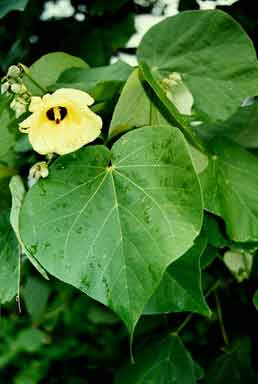
Description: The relatively common to abundant Beach Hibiscus (Hibiscus tiliaceus) is an evergreen, much-branched, small tree that typically grows to 3-10 m (10-33 ft) in height with a sprawling form. In some places this tree forms an erect, gnarled, crooked tree of low or medium height, while in other places it spreads horizontally over the ground in thickets, thus forming an apparently impenetrable network of trunks and branches. The round, variable-sized, heart-shaped leaves are more or less leathery, about 5-25 cm (~2-12 in) wide with entire or scalloped edges. The tops of the leaves are mostly smooth, while the lower sides are whitish with small matted hairs. It produces many flowers, about 5-8 cm (2-3 in) long that are produced at and near the branch tips, When the flowers open they form bright yellow cups, some with dark red centers; however, as the day progresses the flowers change color to a rather dull orange, and then by nighttime are dullish red. The calyx cup is five-toothed, downy persistent, and about 2.5 cm (1 in) long; the 10 to 12 accompanying bracts are shorter. The fruiting capsule is downy and ovoid in shape, about 2.5 cm (1 in) long, and has five valves which contain three smooth seeds (e.g., see Otobed 1968).
Distribution: It is unclear if H. tiliaceus originated in tropical Asia or tropical America; “the seeds can remain viable after floating in seawater for several months, which partially accounts for the tree’s wide dispersal,” and because of “its many traditional uses, beach hibiscus has doubtless been spread by humans”(Elevitch and Thomson 2006:394; also see Thaman and Whister 1996). Indeed, H. tiliaceus is widely believed to be indigenous to many parts of the tropics and also has been introduced to new regions by people. It is possible that some varieties of H. tiliaceus were artificially selected by humans and then transported to islands or other environments where this species already existed as a native species, and was also possibly brought to other areas first by people (this situation may also apply to the origins and distribution of the very useful Pandanus tectorius tree). H. tiliaceus is found today on many if not most tropical Pacific Islands, those in Micronesia where it is probably native, but also because of its multitude of traditional uses it is broadly cultivated and naturalized (escaped from cultivation and growing spontaneously). H. tiliaceus plants are highly variable in form, leaf and flower color, etc., and several taxonomic varieties have been recognized. The fast growing Beach Hibiscus commonly grows in habitats along the seashore and in back of mangroves, where its growth indicates the high water mark and the boundary between the end of salt water penetration and the beginning of freshwater swamp. H. tiliaceus does well on its own in a wide range of soils, including inhospitable brackish swamps, waterlogged soils, and limestone, but is most at home in coastal and near-coastal environments. However, it has also been introduced by people into agricultural environments up to 800 m (~2600 ft) elevation. Today, H. tiliaceus remains mostly in well-watered lowland environments, and thus can be found growing in profusion along some streams. Once established, H. tiliaceus often persists and spreads, especially in moist gullies, streambeds, and other wet areas where it can become a dense mass of tangled limbs and leaves; therefore, it can sometimes be considered as an invasive species especially in disturbed or open forest and in degraded upland areas. It tolerates salty ocean air currents, but very strong winds can cause trees to fall over, which contributes to its tangled and intertwined branching form (see e.g., Elevitch and Thomas 2006).
Uses by Island or Island Group: The Beach Hibiscus, H. tiliaceus,is “culturally significant” throughout most of the tropical Pacific (e.g., see Elevitch and Thomson 2006). This woody species can provide a coastal windbreak, be used as hedge or boundary plant, and is often used to make a living trellis or fence posts. In addition, this multipurpose species is widely appreciated “by Pacific peoples for its contributions to soil fertility” (Falanruw 2015:140), and its light but relatively sturdy wood is used for canoe parts, crafts, short term utility, for fuel wood and to start fires. The bark of H. tiliaceus contains strong fibers used for making rope, to caulk ships and a variety of other purposes including traditional clothing. To extract the bark from the plant, it is stripped lengthwise from the wood and soaked in water to separate the outer bark from the smooth cream-colored inner bark. These fibrous strips are dried and then woven into rope and used for a number of other purposes. The cordage made from this plant has the unusual property of being stronger when wet. Among the wide variety of items that Beach Hibiscus cordage is used to make include handicrafts, fishing nets, hammocks, mats, slings, bow strings, net bags, string for sewing or making flower garlands. Clarke and Thaman (1993) provided a description of the diverse uses of H. tiliaceus in the Pacific region including those especially in the Hawaiian Islands and in Micronesia:
“One of the most useful trees in the Pacific; commonly planted as living fencing and animal pens and in coastal areas, near houses, in gardens, and as an ornamental or shade tree; a creeping variety planted as wind-break in Hawaii; its presence in forested areas considered a sign of former cultivation in Hawaii; features in eastern Polynesian legends and Hawaiian fire-making legends; commoners not allowed to cut branches without permission of chiefs in Hawaii; branches borne in battle by priests as a good omen and allowed to fall in retreat in Hawaii; born by attendants at presentation of first fruits to kings on Easter Island; branches used as tapu markers to delimit restricted areas in Hawaii; used to make spears used in typhoon magic in Ulithi; soft wood used in light construction and wood carving, for house rafters, pig-tethering posts, for canoe outriggers, spreaders, bailers, booms and occasionally hulls, fishing rods, hoists and floats, fishnet frames and handles, bows, fruit-picking rods, tools and tattooing comb handles, kite struts, jackstraw sticks, pestles, breadfruit splitters, coconut huskers, net floats, spears, shore-line posts to delineate fishing zones, fishing gear containers, noddy bird net handles and frigate bird nesting platforms (Nauru), and other purposes; a decent firewood, especially for slow smoking; used in making fire by friction; wood dried for six months used for fireworks in Hawaii; bast [fiber] used as canoe caulking and to make cordage for clothing and dancing skirts and kilts, coconut-climbing bandages or foot harnesses, mats, sandals, sewing tape, bark cloth paint brushes, making fishnets, fishing line and lures, slings, kava strainers, sandals, tying corpses in tape, and cordage for tying, lashing and binding canoes, housing, and other things; bark used to strain kava in Pohnpei to give it its preferred slimy consistency; leaves, terminal buds, unopened flowers, and bark used medicinally, with leaves being used to reduce hemorrhaging and for treating neurological disorders; leaves used to parcel food, especially seafood, as plates, and to line and cover the earthen oven; leaves widely used as toilet paper; flowers used in garlands in Hawaii; bark, shoots, and sapwood eaten in New Caledonia and other parts of Melanesia; leaves occasionally added to compost in Kiribati and Tuvalu; a number of distinct varieties or cultivars recognized in Melanesia and Polynesia.”
Uses in Palau: Hibiscus tiliaceus, the “beach hibiscus,” known in Palauan as Chermall or Ermall, has long been used as a light but useful wood and fiber source. For example, although metal has replaced wood for many uses in Palau, tool handles continue to be made in these islands from a number of native woody species, including H. tiliaceus. The “beach hibiscus,” species has also long been used in these islands to make canoe paddles (e.g., see Tuyama 1941); and the cordage made from H. tiliaceus fiber is “used in construction, to carry loads, to tie food packets and for numerous other everyday tasks” including its use in the making of grass skirts for first-birth ceremonies (Kitalong et al. 2011:72,79, also see Salmi-Saslaw 1988 for a lengthy discussion of the Palauan women’s skirt, the cheriut skirt with reference to bast fiber use of H. tiliaceus).
Hibiscus tiliaceus fiber has also been used for traditional fishing of sharks in Palau beyond the outer reef slopes of these islands. Indeed, Palauan fishermen seldom ventured much beyond the outer reef slope of their islands because of the productive and extensive reefs and lagoons provided the native people with more than enough seafood; however, Johannes (1981:14-15) described the specialized type traditional offshore fishing known as oungeuaol, which was practiced by a few prestigious specialists who during the of the northeast trades on “special occasions at the request of the chiefs fished the open ocean for several species of sharks” (also see Kramer, 1929; Kubary, 1895). Johannes’ informant told him why these oungeuaol fishermen “ventured far from shore to catch sharks when they were so abundant nearer to shore around channel mouths and along the outer reef slope.” The informant indicated “that the species encountered offshore were generally less dangerous than those caught in shallow water.” Johannes described the methods of these specializedPalauan shark fishermen: “…sailed up to ten miles off the east coast of Babeldaob looking for floating driftwood around which they knew sharks often congregated. Flying fish were caught and used to lure the sharks close to the canoe where they were caught with a noose made from hibiscus fiber”(see Johannes 1981:94 for more detail, italics added here for emphasis).
Athough sharks were previously an esteemed food among the Palauans, these predator fish are not especially popular today, even though they are common around reefs of Palau. Their former prestige, was reportedly “related not to their flavor, but to the romance and danger associated with their capture [and the special oungeuaol] fisherman had a special tattoo on his wrist [and when] holding out a flying fish to entice a shark to swim through the noose, he was not supposed to let go of the bait until the tip of the shark's snout reached the tattoo” Johannes (1981:94??). This special shark fishing disappeared over a hundred years ago because it was “discouraged by Spanish and German colonists” who noted that it was not only dangerous, but also involved long periods of work preparing for a elaborate festivity related to the completion of the shark hunting expeditions (Johannes 1981, also see Kubary 1895; for details concerning the elaborate, time consuming preparation of the “nuts” of the tropical almond tree (Terminalia catappa known in Palauan as Miich) which “were pounded and mixed with coconut syrup and starch in order to create shark sculptures as much as three feet high and six to eight feet long” and only sparingly consumed by the celebrating Palauans (see the data base section focused on Terminalia catappa).
Reportedly, a traditional Palauan legend refers to a sacred hibiscus tree, most likely Hibiscus tiliaceus, on Kayangel (Ngcheangel) Atoll, which today is the northernmost state of the Republic of Palau; and Kayangel (Ngcheangel) Islet is the largest and only inhabited islet (lowlying coralline island) of Kayangel Atoll and Kayangel State.
“Long ago, there was a man who was very angry with his wife. He was so angry that he sent her into the ocean on a raft. However, the gods had warned the woman about her husband's plan, and because of this she was prepared with supplies the gods told her she would need. Days later, when the woman had drifted far outside the reef, she scattered the ashes[?] over the ocean as the gods had instructed. She then stuck the hibiscus branch into the bottom of the sea and covered it with the coconut shell. This created an island and the woman was saved. The island is now known as Kayangel [Ngcheangel] , and the scared hibiscus tree still grows” (http://www.pbs.org/edens/palau/p_legends2.htm, italics added for emphasis).
It is noteworthy that Putney (2008:118) referred to ongoing existence of this “sacred hibiscus tree, located in the southeast part of Ngcheangel Islet.”
Hibiscus tiliaceus has also reportedly been used medicinally in Palau. For example, Okabe (see Defillips et al. 1988:17), referred to a treatment for a type of venereal disease in Palau with the use of a handful of crushed H. tiliaceus flower buds mixed together with pieces of the white, tender root of a Pandanus species which was “filtered through the fibrous network of a coconut leaf-base and drunk.” On Tobi Island in southern Palau, the inner back of H. tiliaceus, known as Hirafou, has reportedly been used with the inner back of other plants to make a symptomatic remedy of tuberculosis (Black 1968).
Uses in Yap: H. tiliaceus is known as Gaal’ in Yap, where it forms almost impenetrable thickets in many coastal areas, in lowland habitats, and some well drained, steep hill and mountain slopes in upland forests. Two varieties of H. tiliaceus are recognized in Yap, one red and another white, identified by the “sprout leaves.” The leaves of this shrub or small tree are used to hold pounded balls of sticky food, usually prepared for elderly people. They are also used along with taro and banana (Musa textilis) leaves to cover clay cooking pots. Children make sails from the leaves of H. tiliaceus for their toy canoes. In addition, the leaves make good mulch because of the nutrients they provide when they decompose into the soil. This mulch is used to cover young yam plants in the gardens so that moisture is retained during the dry season, or until yams become well rooted. Indeed, Falanruw and Ruegorong (2002, 2007) discussed the research need to study the nutritional value of Hibiscus tiliaceous leaves: “While indigenous gardeners on Yap and other islands in the Pacific regarded this species as enhancing soil fertility, there appears to have been no studies of its characteristics.” On Yap, weavers have woven traditional loincloths using fibers extracted from banana (Musa textilis)fibers, and those of H. tiliaceus. In addition, bast fibers from H. tiliaceus have been traditionally used to make “nets and dancing ‘grass’ skirts” (Falanruw 2015:140), as well as to make ornaments for the loincloths. H. tiliaceus bast fiber was also formerly used in Yap to line traditional “raincoats” to make them warmer (see similar use on Satawal Island below). Light wood of this plant is often used for firewood, and is sometimes cut into small pieces to make local net floats; in addition, the light, resilient wood of this useful lowland tree is used to make the frames of fish nets, and to fabricate the ribs of traditional boats because the wood does not rot easily. There are also a variety of medicinal uses for H. tiliaceus in Yap. For example, the bark has commonly served as “band-aid” material to help stop bleeding. Okabe (see Defillips et al. 1988:10) referred to the use of sap derived from crushed roots and flower buds of H. tiliaceus being mixed with coconut oil and “taken several times a day” to alleviated “a deficiency of mother's milk.” Okabe (see Defillips et al. 1988:17-18) also referred to other medicinal uses of H. tiliaceus on Yap: for instance, the young leaves are said to be crushed together with new stems of “arrowroot” (Tacca leontopetaloides, known as Chabchab on Yap) and the extracted sap from this crushed mixture had therapeutic value; in another example of its medicinal use, women in some areas of Yap are said to have facilitated an easy, early birth delivery using crumpled leaves of H. tiliaceus. Okabe also referred to a more complex treatment to bring on a relatively gentle, early birth delivery in which the bark of H. tiliaceus is stripped from its branches and hung upside down so the mucilage can be scraped from the inner part of the bark; this mucilaginous sap is then mixed wood ash of the Tahitian Chestnut, Inocarpus fagifer (known as Buqöy in Yapese) “and something like dough is made,” which is then “put into a coconut shell and dissolved with-coconut milk, to which coconut oil is added and then taken twice daily…. commenced when throes are felt for the first time and is continued until the time of delivery.” In addition, Okabe reported that the extracted sap of the inner bark of H. tiliaceus mixed together with juice of a young coconut has been used to treat diarrhea in Yap. The roots of this species are reportedly use commonly mixed with other materials for blood vein problems.
Uses on Ulithi Atoll: H. tiliaceus is known as Guilfoeyon Ulithi Atoll, where the fibers are mixed with banana fiber and used traditionally to weave twine and fish lines, as well as to make the relatively coarse man’s loincloth and women’s wraparound skirt (Gulfoy); these fibers have also been used on Ulithi to make a special garment (puch) worn by small boys over their genitals, and sometimes the skirt (sif) worn by young girls. These Ulithian skirts are traditionally smade from buff-colored fiber extracted from two types of plants: (1) the cultivated Musa textilis, a banana species (Yiiuch in Ulithian, native to the Philippines where it is known as Abacá or “Manila Hemp”), and (2) the beach hibiscus species (Guilfoey, Hibiscus tiliaceus). The following references to the cultural significance of these Ulithi skirts comes from a presentation made in 2006 for an ethnobotany course offered at the College of Micronesia on Pohnpei by a Ulithian student (http://www.comfsm.fm/~dleeling/ethnobotany/63material_culture.html):
“As an acknowledgement that a girl has become a woman, the sisters of the father of a girl will make a gulfoy for her [i.e., a wraparound skirt made of woven fibers from M. textilis, Yiiuch and H. tiliaceus, Guilfoey]. The gulfoy [wraparound skirt] is also used as a gift with special significance, often being presented by outer islands to the chiefs of Yap proper. The gulfoy can also be used to wrap a body prior to burial. Another use is the presenting of one or more gulfoy when one family seeks forgiveness from another…. Once a young woman has a gulfoy, she was traditionally considered ready to marriage. Receiving a gulfoy was a mark of coming of age for a young woman.”
The fibers of Guilfoey (H. tiliaceus)have also been commonly woven on Ulithi Atoll to make baskets to hold food and betel nuts, as well as to tie various things together. In addition, the wood of Guilfoey (H. tiliaceus)is used on Ulithi in house construction, canoe making, fires, and in the production of the typhoon magician's spear. Furthermore, the bark of this hibiscus plant is traditionally used on Ulithi to treat constipation and ear discharge believed to be caused by eating a tabooed octopus, which supposedly angered a spirit. Flowers of H. tiliaceus are also used in the making of garlands or leis on Ulithi.
Uses on Ifaluk Atoll: H. tiliaceus is known as Gilifeo on Ifaluk. Lessa (1977:163) summarized a variety of uses of this plant on Ifaluk: “the bast [fiber of H. tiliaceus] is also woven into men’s loincloths (mixed with banana fiber) and women’s wraparound skirts, twisted into twine and fishing line, and used as a band between the feet for climbing trees; the wood is used for adze handles and spars in canoe sails; the wood burns well and is used for starting fires; the leaves are used to cover food.”
Uses on Woleai Atoll: On this atoll, Alkire (1974:2-3) indicated that the Woleaian name of Hibiscus tiliaceus is “Gilifa”[Gilifeo, according to the Woleaian dictionary, with the silent last vowel]. Alkire’s informants told him that H. tiliaceus occurs in the Nïmel (the interior vegetation of the atoll’s islets); and that “Gilifa cha,” a “variety” of H. tiliaceus, is found in Pi (the coastal strand vegetation of the atoll’s islets). According to Alkire “The seeds of this plant [Gilifa cha] are said originally to have come from the sea,” which may refer to the ability of H. tiliaceus to establish new individual plants from its mature seeds, or via stem and branch cuttings (the latter refers to vegetative reproduction naturally or by human planting clones of this plant).
Uses on Satawal Island: Fosberg (1969:8) noted that H. tiliaceus could be found in some parts of the village on Satawal, and in “nearby parts of forest.” Fosberg listed the local name on Satawal of this hibiscus species as “Kilifu,” but Roddy (2007:137-138, 170) recorded the Satawalese name for Hibiscus tiliaceus as Kinefeo [according to the Woleaian dictionary, H. tiliaceus is listed as Gilifeo]. Roddy indirectly described one of the fiber uses of “Hibiscus”(most likely H. tiliaceus) in thick, woven coats, as noted in the second “interlinear text” of three well-known “Folktales of Panuwnap” [Satawal]. This information was originally collected “in the early 1980’s on Satawal, by Kenichi Sudo and Sabino Sauchomal,” who learned of this folktale “from Namonur (Isadore), a renowned canoe builder and navigator” (According to Roddy, interlinear texts of each of these folktales were published in the Japanese Language Bulletin of the National Museum of Ethnology, Osaka, Japan):
“As the canoe neared the island, Rongorik ordered “Take off your jackets.” (These were coats worn in the days of old, made of hibiscus, and woven in a way to be tied all the way up to the neck. The material it is made of is very thick, and it makes the wearer very hot when worn). One man in particular untied his coat and put it under a palm mat in the canoe” (Roddy 2007:137-138, italics added for emphasis).
Uses in the Mariana Islands: Hibiscus tiliaceus, is known as Pago or Pågū in the Mariana Islands, where it is found in the limestone forest, along muddy or sandy coasts and in mangrove swamps, growing in thickets in both calcareous and volcanic soils. It has many traditional uses in the Mariana Islands including as an ornamental and a shade tree, as well as for making cordage, medicine, furniture and canoes (Zarones 2014; also see Falanruw et al. 1989). According to Safford (1905:346-347) a century ago this species was abundant and had many uses:
“The natives make cordage of its inner bark, nearly every family being provided with rope-making appliances. The ropes are used for halters and lines for tethering cattle and carabaos, for harness, and for cables for ferrying the bamboo balsas, or rafts, across the mouths of the rivers on the east coast of the island. The strength and durability of the ropes are much increased by tarring.”
According to some sources, ancient Chamorro people used the bark from H. tiliaceus trees, or bamboo, to make woven fish nets (talaya) and traps (Anderson-Taft 2015) in the Mariana Islands. Moore and McMakin (1979:28) briefly described the process of making and using bast fiber cordage from the bark of H. tiliaceus on Guam:
“The fibrous bark of the long, erect water sprouts is stripped from the wood, soaked in water and dried to be woven into cordage. The unprocessed bark is also used by hunters or farmers as an immediate source of cordage for binding game or produce….”
McMakin (1978:46) referred to the medicinal use of the crushed flowers of H. tiliaceus which were applied to abscesses: “The crushed blossoms of this indigenous tree are applied to boils to draw out the infection.” McMakin (1978:56) also referred to the use of the dried leaf of Hagun Pago (H. tiliaceus) in a traditional “medicine for muscle or arthritic pain” that involves a combination of plant parts from a variety of species found on Guam.
Uses in Chuuk: H. tiliaceus is known as Sinifé or Kilifi in Chuuk, where it has many uses as elsewhere in Micronesia. Traditionally the lightwood of Sinifé was used as a plough to start fires. Because the lightwood of the plant is easy to burn it also serves as fuel. Although it is light in weight, the wood of Sinifé is strong and easily carved into a variety of small implements, as well as canoe paddles, canoe bailers, other canoe parts and house parts. In addition, it is used to make the special poles (iyas) used to pick breadfruit (Mááy). Fishing equipment such as poles, floats, and fish net frames like those used to catch flying fish are also made from the lightwood of Sinifé. A black paint (épwpwún) is made from a combination of pigment extracted from charred Sinifé wood, leaves of Achorong (Hernandia nymphaeifolia), and sap expressed from the bark of a mangrove tree. In addition, pliable and relatively strong fibers can be extracted from the inner bark of Sinifé. Before the Japanese arrived, the fiber from this plant was used to make traditional clothing. This clothing, in the form of mats and skirts for men and women, was woven on a horizontal loom using the fibers extracted from Wuuch (a type of banana, Musa textilis) and Sinifé bark. Sinifé fiber has also been used in the traditional construction of fans and cordage in Chuuk. In addition, a kind of mosquito net (towunómw) was “woven on a horizontal tension loom from plain, undyed [Sinifé] fibers using a coconut leaf midrib needle and [Sinifé] fiber thread” (Lebar 1964; also see Lessa 1977:163-164). The attractive yellow flowers of the plant are sometimes used for head and necklace garlands, and leaves of Sinifé are used to wrap food that is put in the oven. Medicinally, leaves of Sinifé are mixed with coconut juice in a coconut shell cup and drunk during pregnancy to help delivery, and the flowers are sometimes rubbed over skin rashes as a cure, and for treating eye ailments. As a magical medicine the fruit of Sinifé has been “used against sea spirits.” Sinifé is also said to improve the fertility of the soil in which it grows. This plant is also very useful and important where it occurs on the outer coralline islands of Chuuk State in the Federated States of Micronesia (see below).
Uses on Puluwat Atoll: H. tiliaceus is known as Kilife on Puluwat, where it is plentiful only in swampy depressions on Alei Islet. The wood of this wild hibiscus is used to make breadfruit picking poles (yiyah) and fishing net floats; and fiber extracted from the bark was used in weaving clothing.
Uses on Namoluk Atoll: H. tiliaceus is known as Kilifo on Namoluk, where this useful plant reportedly only grows in or very near the taro swamps at the middle of the three largest islets of the atoll. It is said to have or have had many uses on this island: “the wood is used in house construction, for the outrigger struts on paddling canoes, as poles for poling canoes on the reef, for the long poles used in picking breadfruit, in the manufacture of modern canoes, and in making men’s dance ornaments; the young leaves, bark, and unopened flowers are used medicinally, especially for women; the bark fibers are used in weaving cloth and in making fish nets, slings, and twine, as well as in tying the umbilicus of new born infants” (Lessa 1977:164; also see Marshall 1975:39, (Girschner 1912: 131, 137, 157, 167).
Uses in Pohnpei: H. tiliaceus is known as Keleu, Kolou or other local names in Pohnpei, where it is a very widespread shrub or small tree, and, as noted above on many other tropical Pacific Islands, is one of the foremost multipurpose trees: “Almost every part of the plant is used for cultural purposes.” For example, it is used for firewood because it is easy to burn. Its wood is used in light construction including to make parts of canoes, e.g., the upper part of the hull is reportedly made of a lighter wood such as H. tiliaceus; in addition, poles or whole trees of this common hibiscus plantare used for yam trellises, and its leaves are composted as green manure in soil pits dug for yam cultivation. The useful bark of this abundant plant has been used to make traditional clothing and is processed into rope on Pohnpei; its bark provides the favored fibers for straining pounded rootstock of Sakau (kava or Piper methysticum) which is immersed in water for drinking on Pohnpei (Raynor and Fownes 1991:140; also see Lebot et al. 1992). H. tiliaceus is said to have replaced coconut (nih) fibers for Sakau straining; these hibiscus fibers have also been used in the construction of fishing nets. Since coconut fibers are also said to have replaced the original straining fiber that was obtained from Aiau (Ficus prolixa), both the coconut palm (Cocos nucifera) and Beach Hibiscus (H. tiliaceus) may have been introduced to Pohnpei by people in earlier times.
There is a Pohnpeian story about a raft made of Keleu that was brought in during the time of the Saduelers (during the time of Isohkelekel who invaded from the island of Kosrae). According to this story, the Kekeu raft was dragged in by canoe from somewhere to the west of Pohnpei Island. It is said to have gone by Saipan (sai, which means “searching,” and pan, which means “mackerel,” are Pohnpeian words) and, according to this traditional story, when this raft arrived in Pohnpei it brought in the Keleu plant (H. tiliaceus) for the first time.
Two Pohnpeian proverbs (Lepin kahs) referring to Keleu (H. tiliaceus) on Pohnpei are presented below:
1. Tehn Keleu marahra -- “(He is) a light hibiscus leaf.”
“Leaves of the wild hibiscus tree are fairly large, light and flutter in the wind. This phrase is applied in derision to a man whose opinions are fickle or who cannot follow through on things he has started” (Reisenberg and Fischer l955).
2. Keleun ieng soupeidi – “A chief is a hibiscus in the wind.”
“The wild hibiscus tree sends up tall, flexible shoots which bend easily in any direction. According to two informants, this proverb sets a standard of fairness for the chiefs, who are supposed to respond to the needs and requests of any of their subjects, just as the hibiscus tree bends with a wind coming from any direction. According to a more caustic informant, the proverb refers to the readiness of the chiefs to favor anyone who will bring them plenty of food at feast, regardless of the other requirements of the situation” (Reisenberg and Fischer l955; also see Hanlon 1988:113).
A student in an ethnobotany course offered at the College of Micronesia on Pohnpei reported the following information about the usefulness of this important plant on that island:
“The Hibiscus tiliaceus or koaloau is an important plant to the people of Pohnpei ever since a long time ago. Pohnpeians use almost every part of the plant for certain cultural purposes. A long time ago, there were no clothes on Pohnpei, so the people had to dry the inner bark in order to make grass-skirts. Back then, grass-skirts were used as clothes, but today they are made specifically for cultural dances and displays. Aside from being made into grass-skirts [e.g., the traditional koal worn by Pohnpeian men; see Anson and Raynor 1993:144], the slimy, inner bark of the plant is used for the sacred ritual of preparing the local sakau or kava. This inner bark is separated from the outermost bark, rubbed with water, and then it is used to squeeze the sakau. The inner bark of the hibiscus and the sakau work together to form a very significant part of our culture which is the preparation and drinking of sakau. The hibiscus tree is also necessary for healthy sakau production. These trees are cut down on growing sakau in order for the sakau to grow faster and bigger. Furthermore, the bark is important for yam production. Pieces of the bark are dried and tied together for farmers to use. Farmers help the vines of their yams climb up trees by tying one end of the tied bark to the base of the vine, and the other end in a tree. As the vine grows higher, it twirls around the tied barks all the way up into the tree. The leaves of the Hibiscus tiliaceus [are] also important for food preparation. Smashed or pounded local food are wrapped in the leaves before being cooked. Some people also cover their cooking pots with hibiscus leaves before cooking their food. The leafbuds too, are very important because they are used as some form of medicine by the people of Pohnpei. When a person has a swollen skin bruise, the leafbuds are crushed, wrapped in a piece of cloth, and put in a cup half-filled with water. The person then gently massages the swollen bruise with the wrapped medicine. It is kept wet, and used over and over until the bruise is no longer swollen. The leafbuds are also used for some superstitious beliefs in Pohnpei. For instance, if a group of people are going to do a cultural display before a large crowd filled with strangers, they usually take a shower with water that contains crushed leafbuds before the sun rises on the day of the display. It is believed that this shower helps take away nervousness, and any other feeling that may interrupt one's concentration. The yellow flowers of the hibiscus plant is used mainly for head leis or mwaramwar and other forms of decoration. The stems, when alive, are used for carrying things like yams, breadfruits and other heavy farm products. A long pole used for breadfruit climbing is also made from the hibiscus tree. However, when the trees are dead, the stems can sometimes be used as firewood. Finally, the Hibiscus tiliaceus is very important for the people of Pohnpei because almost every part of serves some special purpose” (http://www.comfsm.fm/~dleeling/botany/1998/vhp/bruno02.html; also see Balick et al. 2009:429-431, for more detail regarding the multipurpose use of H. tiliaceus on Pohnpei).
For example, the therapeutic usefulness of H. tiliaceus is more specifically referred to by Balick and his colleagues (2009:430-431):
“To make wini en loh (a mechanism to treat choking on a fish bone) …. Alternatively, to dislodge fish bones that are stuck in the throat (one of the most important medicines in Pohnpei, the medicine is very effective because the sap is very slimy and acts as a lubricant) …. [some of the other therapeutic uses of parts of H. tiliaceus including leaf buds on Pohnpei are] To treat diarrhea, several remedies are reported….To treat gonorrhea….To treat baby or adult fevers…. For children’s fevers…. To treat boils that are taking a long time to heal…. To treat a bruise….To treat a swollen, bruised face such as after a fight… To treat anxiety…. To treat early or imminent labor, the bark is scraped, wrapped in cloth, squeezed into a cup of water, and consumed daily when the mother is six months pregnant until the baby is born and period returns….”
Another student in a College of Micronesia class dealing with use of plants reported and “unusual” use of Hibiscus tiliaceus bark to treat a skin bruise (mwou):
“The treatment was unusual in that six inches of bark are boiled in water until the water turns brown, then the water is drunk as a tea. This is unusual as the bruise is external and treatments for external skin issues are usually also applied externally. This is an internal treatment” (http://danaleeling.blogspot.com/2014_09_01_archive.html).
Uses on Pingelap Atoll: H. tiliaceus is known as Kalau on this atoll which is part of the Pohnpei State of the Federated States of Micronesia. On Pingelap, the fibers from the inner bark of H. tiliaceus “are used in making rope, fish line, hats, and baskets, and the leaves are often used in washing clothes” (Lessa 1977:164).
Uses on Mwoakilloa (Mokil) Atoll:H. tiliaceus is known as Keleu or Kalau on this atoll where it is reported by Glassman (1953:300, coll. 2653) to be commonly found in the coastal “strand, up to “50 feet high.” Glassman also noted that fibers extracted from the bark of this species “are used in making rope, fish line, hats, and baskets, and the leaves are often utilized in washing clothes.” It has also been reported more recently that H. tiliaceus has a number of uses on Mokil, including some that are medicinal; for example, similar to its use elsewhere (e.g., on Pohnpei), H. tiliaceus is reportedly used to reduce the swelling of a bruise on this atoll by using unopened leaves of this plant which are chewed, mixed “with a small amount of oil” and then applied repeatedly to the bruised area of the body for sustained amounts of time (see http://www.comfsm.fm/~dleeling/ethnobotany/healing_plants_presentations.html).
Uses in Kosrae: H. tiliaceus, known as Lo on Kosrae Island, where the light wood of is used to make fishing floats and poles. In addition, on Kosrae the branches Lo are used to make the frames for two kinds of fish nets used by women in reef fishing. Friedrich Kittlitz, senior naturalist aboard the Senjavin, noted the following: "Numerous fish of awe inspiring diversity were in motion around these stems of stone plants [corals]; but for want of tools and practice, we were not in the position ourselves to catch them and obtained them only from the natives, who attended to the fishing with the ebb tide. We especially saw the females, sometimes in large groups, engaged in it almost daily. They especially made use of hand nets with arched frames. Only occasionally were the women, whose task it was especially to catch the beautiful, non-social coral fish, accompanied by men" (Ritter & Ritter 1981:172).
According to another account, " . . . deepsea fishing has apparently never been of special significance ... the Kosraeans applied themselves all the more to reef fishery, which was in its heyday since time immemorial, and is pursued with virtually all the fishing methods commonly practiced in Oceania. In particular, the lucrative net fishery has developed in many and varied forms" (Sarfert 1919:101). The German ethnographer Ernst Sarfert suggested that Kosraean women were able to participate extensively in the net fishery because of its simple gear and skill requirements. A more likely reason for women's extensive involvement in near-shore fishing is that it is easily combined with childcare responsibilities. It is a common sight in Kosrae and elsewhere in Oceania to see women net fishing and reef gleaning accompanied by small children.
……and the fiber from the inner bark (ne) of Lo is a readily available source of temporary cordage to tie objects together, make thongs, etc. The lightweight branches of the plant also have several traditional uses for canoe construction. Because its lightwood is easy to burn, Lo also serves as a fuelwood, and Lo is said to improve the fertility of the soil in which it grows.
Historically, traditional net fishing has been a highly developed and varied activity on Kosrae. During the early part of this century, nine different types of fishing nets were reportedly in use (Sarfert 1919). Each was designed for a specific fishing technique, marine habitat (i.e., reef flat, mangrove channel, or outer reef), tide (high or low), and number of individuals. Of these, two were specifically used by women: the nek musra and the nek moko, both of which were used in pairs. The nek musra, "the everyday handnet of women," was approximately six feet long and traditionally made from hibiscus fiber (Hibiscus tiliaceous). The nets were attached to two pieces of fienkek (Premna serratifolia), a salt-tolerant shrub commonly found near the shore. One piece was long and curved and the Des Rochers: Women's Fishing on Kosrae 9 other T-shaped with the edge of the net attached to it. The two pieces were lashed together with twisted lengths of hibiscus fiber. The net arched upwards slightly and lay slack on the wooden frames, forming a pocket which held the fish. Similar nets have been used throughout Micronesia and Polynesia (Thompson 1940, Severance 1976, Alkire 1977, Falanruw 1987).
Neklap
Individual fisherwomen used pairs of nek musra to practice neklap, a popular form of women's fishing. Neklap (named after the reef heron, Egrata sacra) was undoubtedly the fishing activity that the crew aboard the Senjavin noted in 1827. Neklap continued to be a popular form of net fishing up until the late 1960s.
As many as 100 women participated in neklap at any one time. One woman, designated as "captain," led the others to a particular spot, directing them where to set their nets. The women would form a large circle and then move towards the center, closing it by breaking off into several smaller circles until the fish ran into the nets. Each woman carried a fish basket (Joto in patur) made from palm leaves tied around her waist.
Neklap required not only a large number of women, but also much coordination and cooperation. Although neklap reportedly has been practiced during high tide, many of the older womeh interviewed said the best time was mid-tide. The fish caught by neklap include mullet, parrotfish, and surgeonfish.
Today neklap is no longer practiced, although many older women can vividly describe this method, taught to them by their mother or grandmother. Younger fisherwomen generally have heard of neklap but do not possess sufficient knowledge of either the technique or the steps involved in making the nets in order to practice it.
Moko (from Des Rochers 1992:10-11) [Figure 3. Nek mo/co-traditional hand net made from hibiscus fiber.]
The nek moko was the other commonly used traditional women's hand net and of the same basic design as the nek musra but approximately half its size (Fig. 3). Moko is the primary method for which these nets are used and requires only one woman and a pair of handnets. It is practiced at low tide during a full moon. The nets are placed in a "V" around a loose coral head or rock which is then turned over to scare the fish out from underneath and into the nets. Today several women still practice moko but their nets have been modified in order to take advantage of new technology and materials. The frames are still made from fienkek but the net has been replaced with a section of discarded monofilament gill net. This has the advantage of being stronger, more durable, and less visible to fish than the traditional hibiscus net. Fish caught by this method include groupers (ka/srik), parrotfish (mesrik), surgeonfish (lasrfol), rabbitfish (mweosra) and mullet (ac)….”
Uses in the Marshall Islands: H. tiliaceus is known as Lo in the Marshall Islands (as it also is known on Kosrae), and is a very useful plant. This hibiscus tree is considered by some to be a “canoe plant” (aboriginal introduction) which is found occasionally today in “household gardens, as a roadside tree, in tree groves and in areas near taro pits [with] more extensive stands found in thickets in [some] swampy areas” (Vande Velde 2003:106). The light wood is used traditionally in the Marshall Islands to make frames for nets to catch flying fish and the straight, pliable saplings and branches make good fishing poles. In addition, floats of the light wood of Lo are used to hold a submerged string which attracts shell bearing animals; the captured shells are then used to beautify handicrafts (e.g., see Merlin et al. 1997, Merlin 2002). Those who wish to honor a person of high rank may make a special type of garland or lei from the inner bark of L and cowrie shells.
In the Marshall Islands, the light wood of Lo also furnishes fuel, construction materials for canoes and houses, and fishing gear, such as frames for nets to catch flying fish. In addition, special poles to pick breadfruit (Komkom) are made of L wood. The pliable and relatively strong, useful fiber extracted from H. tiliaceus is known in Marshallese as jab. This fiber was used in the Marshall Islands to make traditional clothing for both women and men. It is also used in the construction of fans, hats, baskets and rope as well as for decorating items; indeed, this fiber is traditionally used to provide color for a useful dye. The bast (inner bark) fiber of Lo is traditionally extracted and prepared for construction, handicraft or as a dye in the following manner:
“A young tree with no side branches is cut down and the outer layer scraped off. The trunk is then buried in the sand in the lagoon water to loosen and soften the outer white layer. This stringy layer is then removed, washed, and dried in the sun like kimej [split and bleached young coconut leaves. The jab fiber] is then ready to be used or to be dyed” (Mulford 2006; see http://www.yokwe.net/ydownloads/Handicraftbooklet.pdf).
A traditional dye is also reportedly produced by combining fiber parts of both L and the mangrove roots of Jo (Bruguiera gymnorrhiza). The attractive yellow flowers of Lo are used in the making of head and necklace garlands (ut and marmar). Leaves of L are used to wrap food that is put in the um oven. Medicinally, leaves of L are mixed with coconut juice in a coconut shell cup and drunk during pregnancy to help delivery. The flowers are also sometimes rubbed over skin rashes as a cure.
Uses in Kiribati: H. tiliaceus is known as Te kiaiai or Te rau in Kiribati. According to Thaman (1990:23-24; also see Catala 1957:96), this native coastal tree is sometimes cultivated in or around villages and was probably more abundant in the past; its wood has been used “as the bottom stick in making fire by friction,” its branches are “sometimes used for outrigger booms,” because of their elasticity and straight young sprouts “make good fishing rods,” while the inner bark fibers are “sometimes used to make skirts (riri),” and the leaves are highly esteemed for composting the giant swamp taro (Cyrtosperma merkusii)pits as well as “for wrapping food (larger leaves may even replace Guettarda leaves for this purpose).” In addition, the flowers are used to decorate hair. H. tiliaceus also has medicinal uses in Kiribati.
Uses in Nauru: Thaman (1994:165) provides information about the distribution of the Beach Hibiscus on Nauru Island where it forms “thickets and forest on escarpment surrounding plateau and on inner and outer edges of coastal strip,” and of its many uses on that raised reef island:
“Timber used for house construction and considered good for canoe outriggers, poles for noddy bird nets, and the best wood for the construction of frigate bird nesting platforms (eteo, etea); very soft pieces of wood rubbed together in the past to make fire by friction in the procedure known as ikumo; inner bark (bast fiber) used to make white fiber, which after stripping off outer bark and soaking in mud and sea water, is used to make skirts (ridi), special hula skirts (ingung), and baskets (ebwer, eber); fiber used for straining coconut cream and for lashing house rafters; leaves used for parceling pig and other foods for cooking in the earth oven (eyom, eom); leaves cooked with water as a cure for diarrhea.”