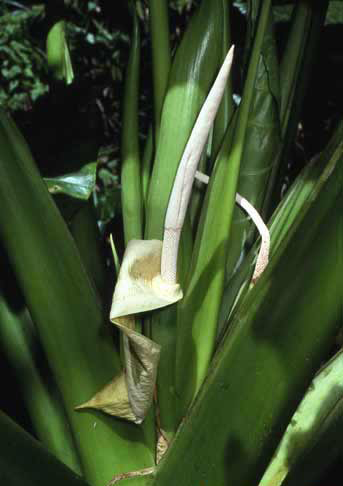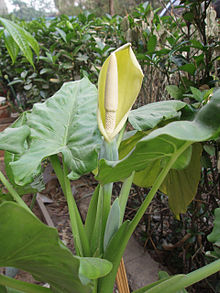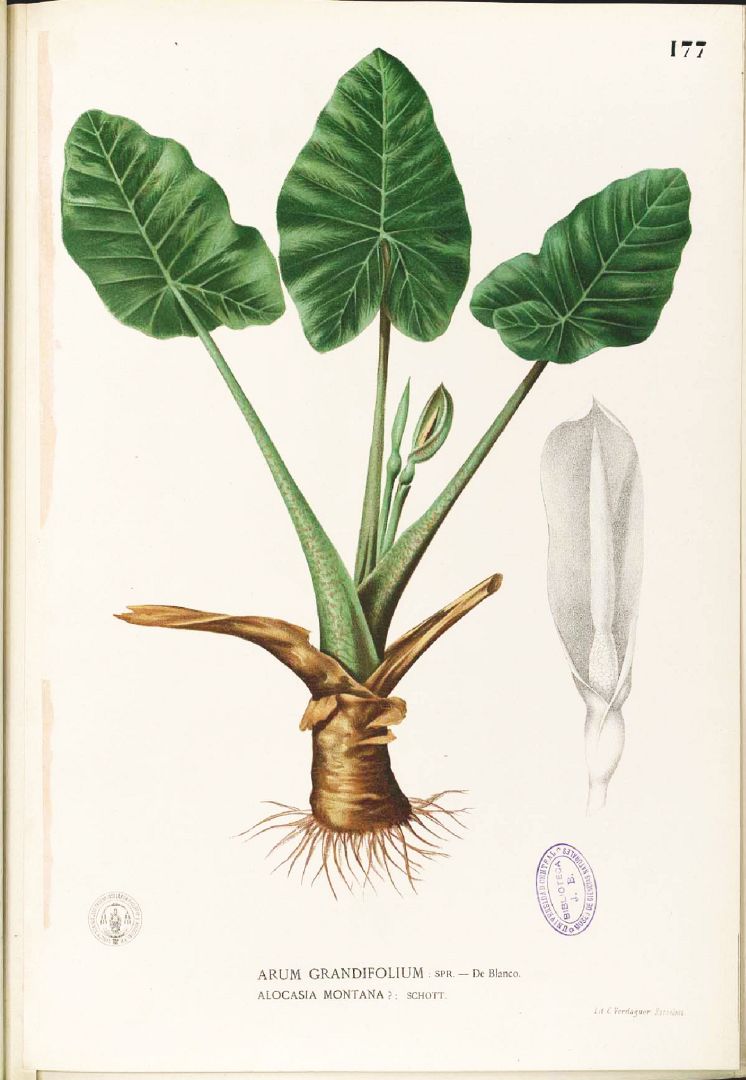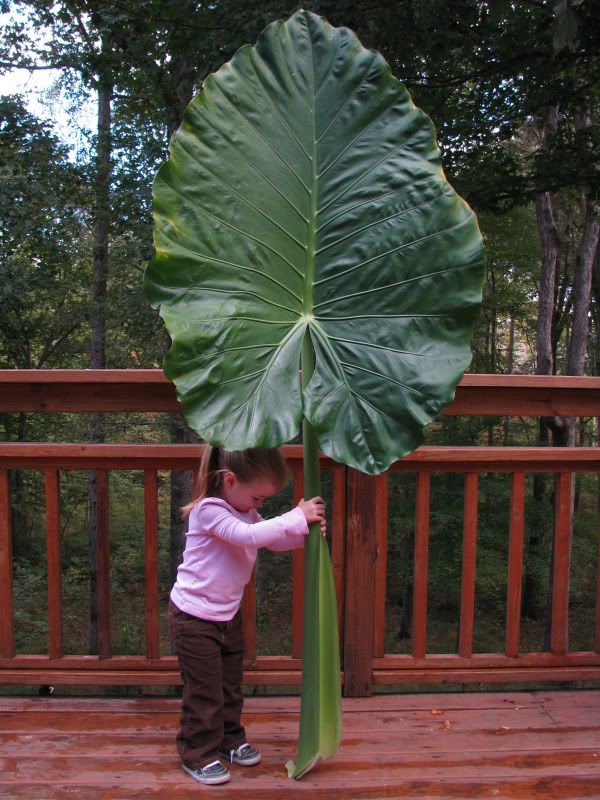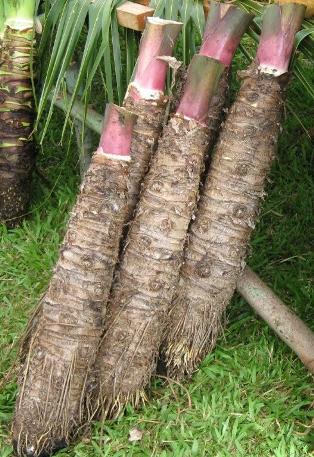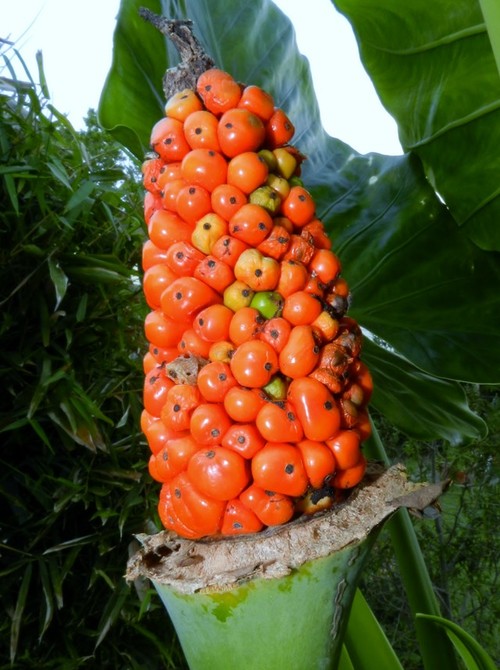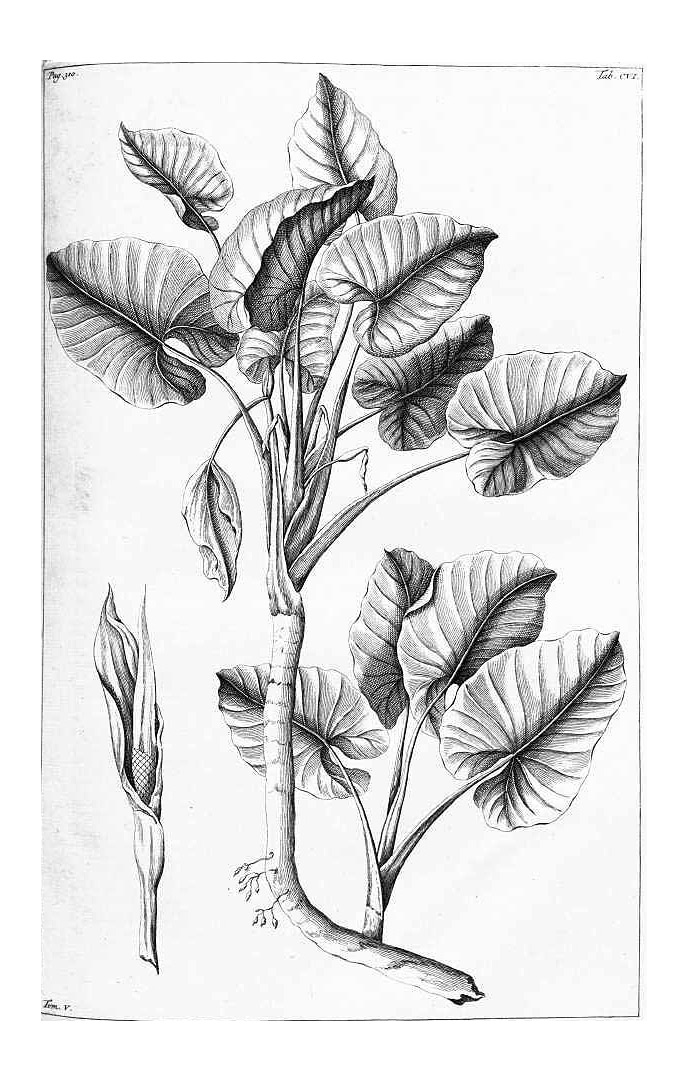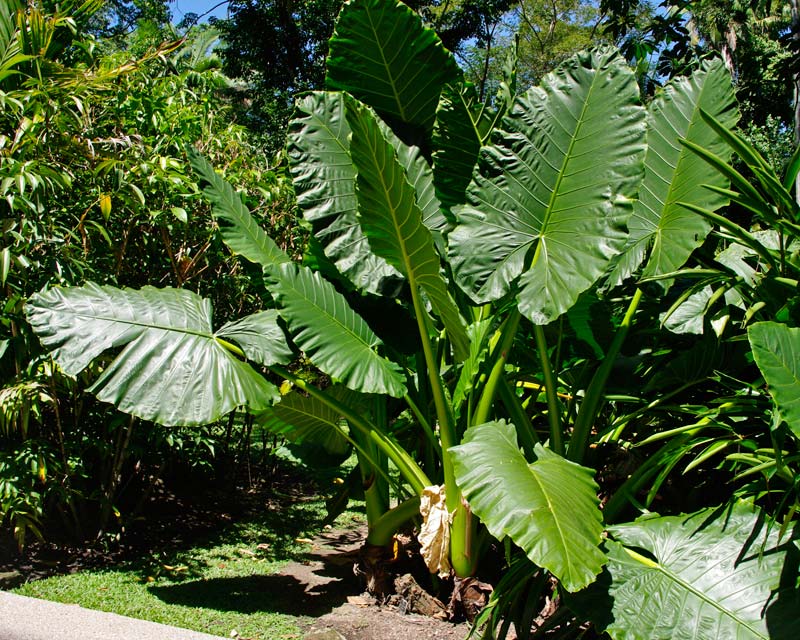
Description: Alocasia macrorrhizos, is a large, spreading, aroid species in the arum family Araceae, and it related to “true taro” (Colocasia esculenta) and the very large “giant swamp taro” (Cyrtosperma merkusii). Known in English as “elephant's ear,” “giant taro” or “wild taro,” A. macrorrhizos is an herbaceous plant can reach up to 3 m (10 ft) or more in height. It develops a thick, erect and ringed trunk (or large stem), up to 20 cm (8 in) wide and 1-2 m (3-6 ft) long, which grows out of the underground stem (or corm). The heart-shaped, shiny green leaves are huge, with 4-7 primary lateral veins per side; the huge leaves are up to 1.5 m (5 ft) long, and tend to point upward. The tiny flowers are borne on a fleshy spadix surrounded by a whitish to yellowish or greenish oblong spathe. The berry fruits are ovoid, 8-10 mm long, and about 5-8 mm in diameter (e.g., see Wagner et al., 1999:1356).
Distribution: according to Manner (2001), the giant taro, Alocasia macrorrhizos is native to tropical Southeast Asia, India, and Sri Lanka; it commonly occurs in humid moist, low, and medium elevation valleys where it is naturalized along stream banks in mainly secondary and disturbed forests and old clearings. Today A. macrorrhizos is found throughout the tropics. In all probability it is an aboriginal introduction into Pacific islands, where it known from all high islands and many atolls. The list of common names above indicates the extent of its Micronesian distribution. It should be noted that some authors have listed the native range of Alocasia macrorrhizos taro as wider than suggested above, stretching from Southern Asia to Western Melanesia in Near Oceania, from where it has been introduced and often cultivated by people in many ot the tropical islands of Remote Oceania. Nowadays, this giant taro species is found throughout the tropics, and may have an aboriginal introduction into all Pacific islands. In any case, this large so-called dry land or wild taro was, in all probability, first introduced into the Micronesian Islands by early prehistoric settlers. In some island areas it has become naturalized, i.e., an alien species growing truly wild on its own. As such it has served on numerous tropical Pacific Island as a famine crop, taking approximately a year to mature. The starchy above ground stems of this plant are rich in thiamine as well as energy rich starch; but like the other cultivated aroids, such as “true taro” and “giant swamp taro,” A. macrorrhizos contains large numbers of calcium oxalate crystals, and thus its parts must be cooked for a relatively long time to become safely edible. The relative safe cooking time is largely dependent on the different, more or less selected varieties of this taro species.
Uses by Island or Island Group: Muller-Dombois and Fosberg (1998:293) described the special food usage and general plant association of giant taro (Alocasia macrorrhizos) in the Caroline Islands of Micronesia:
“Around villages and scattered dwellings are bananas, cassava, small garden plants and numerous ornamentals. The ‘ape (Alocasia macrorrhiza), a large spreading taro with huge (>1-m), upright, pointed blades, is a frequent component in the coconut woodland. Alocasia, which grows well on drained soil, is extensively used as food in the central and western Caroline atolls, though it is generally treated as a famine food elsewhere.”
When used as a major or minor component of the diet in tropical Pacific island, giant taro (A macrorrhizos) is mainly cultivated for its starchy upright stem, which “are roasted, baked, or boiled and eaten as a starch” (Manner 2011). However, as noted above, similar to “true taro” (Colocasia esculenta, also sometimes referred to as “sweet taro”), parts of giant taro (A. macrorrhizos) are edible, but, only after lengthy cooking (for most varieties).
Uses in Palau: According to Okabe (e.g., see Defilipps et al. 1988), in the western Micronesian islands of Palau, juice extracted “from rotten leaves” of giant taro (A. macrorrhizos,known as Bisech er Belau) has been used medicinally to treat burns; and although the sap of the stem and leaves is of this giant taro are generally poisonous and must be treated carefully, in the past, this large taro species was most likely used as famine food status as well as a source of medicine in Palau.
Uses in Yap and associated atolls: Where giant taro (A. macrorrhizos) grows in Yap State today (on the main islands, atolls and raised reef islands), it usually, but not always, only serves as a source of famine food. Indeed, this large “dry land” (non-irrigated) aroid species, which is known as Chaf, Lai or La'iy nikan in Yap, is reportedly eaten during famine times. In addition to survival food usage of the cooked stems of the A. macrorrhiza aroid, the large leaves are reportedly sometimes used as umbrellas on Yap and the atolls (e.g., see Lessa 1977). A couple of unusual uses of the giant taro (A. macrorrhizos) on Yap proper were recorded by Obake in the early 1940s (see Defilipps et al. 1988). Okabe reported that in at least one Yapese area (Giripes District), parts of giant taro were used in the treatment of rat bites: “the bud and leaves [of A. macrorrhizos] are crushed and applied to the affected part,” whereas throughout Yap, Okabe also indicated that the “sap of the crushed stem [of A. macrorrhizos] is drunk as an aphrodisiac.”
Special Use on Ngulu Atoll: Giant taro (A. macrorrhizos) has been planted traditionally as a common source of food on “land poor” Ngulu Atoll, located between Yap and Palau; although Ngulu Atoll has an extensive and productive lagoon, the total habitable land area covers only approximately half of one square kilometer. Indeed, the human inhabitants of the small Ngulu Atoll, currently reside on only one islet which is too small to support sufficient fresh water in its underground (Ghyben-Herzberg) lens to cultivate wetland taro species (e.g., giant swamp taro, Cyrtosperma merkusii or true taro, Colocasia esculenta). As a result, people on Ngulu Atoll have depended upon their planted coconuts, a few seeded breadfruit trees and a variety of giant taro which can be grown on “dry land.” The Ngulu variety of A. macrorrhizos is extremely toxic, but the starchy lower stems are made edible and tasty through a specialized process; this involves sustained cooking of the starchy parts of the Alocasia taro with added coconut sap simmered in clay pots. Rainbird (2004) reviewed the survival significance of this traditional use of man-made containers to cook up a basic food mixture of giant taro starch and coconut syrup on Ngulu Atoll:
“Petrological analysis of pottery sherds recovered confirmed the presence of both Yapese and Palauan wares on Ngulu (Dickinson 1982). Pottery from Palau was rare in comparison to that from Yap. More recently Intoh (1992b) has suggested, on the basis of the limited ethnographic accounts, that pottery was functionally important for the successful processing of toxic Alocasia (dry taro), the major subsistence crop on the atoll, through the ability to simmer coconut sap. Intoh (1992b: 166) concludes: If Ngulu had been rich in plant resources, earth-oven cooking could have been the main cooking method, and pottery would not have been necessary for survival. However, the severe natural environment of this atoll forced the Ngulu people to rely on a highly toxic variety of Alocasia that could be grown locally. The addition of coconut syrup during sustained cooking made it possible for Ngulu residents to eat this carbohydrate-rich plant without adverse effects. In addition, surplus coconut syrup was produced in order to trade with nearby high islands to obtain other food resources and natural materials important for life on the atoll. Among the imported items, of greatest importance was the continued supply of earthenware vessels for producing coconut syrup in the first place.”
Takayama and Intoh who carried out archaeological excavations on Ngulu in 1980, “demonstrated that this small atoll had been inhabited for 1600 years, and containers (‘pots’) were continuously imported from Yap and Palau throughout its occupation history” (Intoh 2008:121, also see Intoh 1981, Takayama 1982, Dickinson 1982, and Rainbird 2004).
Uses on Ulithi Atoll, Lessa (1977:141-142) offered notes on the presence and use of “Alocasia macrorrhiza” on Ulithi where itoccurs mostly as a wild plant “but is sometimes cultivated.” Lessa reported giant taro to be “the least valued of the three arums [aroid species] eaten on the atoll,” with portions of its thick starchy above ground stem the parts consumed when sufficiently cooked. Interestingly, Lessa also noted that on Ulithi, young giant taro plants (A. macrorrhizos) are traditionally employed “by the public fish magician as a safeguard against any possible sorcery against his work.” According to Lessa, the young giant taro plants to be used for protection were “stripped of all but two leaves…painted on the upper side with red crosses,” and only became effective once the fish magician offered as “incantation” over the prepared plants. Although the foliage and outer covering of giant taro are known to the Ulithi islanders to cause stinging, unless carefully handled, according to Lessa, these same “leaves are sometimes used as umbrellas.” In 1947, Lessa (1977:142) recorded five “local cultivars” of A. macrorrhizos on Mogmog Island of Ulithi Atoll: “molui,” “filel Iarepik,” “paielai,” “loi,” and “filel epsech.”
Special Uses on Fais Island: Lessa (1977) referred to Fais Island as “one of the few places where the [giant taro, Alocasia macrorrhizos] aroid is planted for food.” Fais is a small raised coral reef island which is now part of Yap State in the Federated States of Micronesia. The island is only about 30 m above sea level at its highest elevation and was extensively mined for phosphate in the late 1930s and early 1940s, during the Japanese control of the island (e.g., see Intoh and Yamaguchi 1996). Buden and Tennant (2011:116-117) succinctly described the interior vegetation of this raised reef island today as:
“a mosaic of open grassy areas, patches of scrubby, xerophytic woodlands, and numerous small garden plots for cultivation of sweet potato (Ipomoea batatas), tobacco (Nicotiana tabacum), several different species of taro (Cyrtosperma merkusii [=chamissonis], Alocasia macrorrhizos, Colocasia esculenta, and Xanthosoma sagittifolium), and other subsistence crops. Remnant patches of semimesic woodland occur along the rim and at the base of the central plateau.”
Before sweet potato (Ipomoea batatas) was introduced to Fais Island from Yap, probably prior to 1850, subsistence agriculture was reportedly based mainly on “dry land” taro species (Alocasia macrorrhizos and Colocasia esculenta) and bananas (e.g., see Intoh 2008). More specifically, Manner (2011:13-14) indicated, based on his personal observations, that Alocasia taro has a unique role as a cultigen on Fais which he described briefly as “an isolated, small (only 1.9 km2) upraised limestone island in Yap [with] no electricity, supermarkets, or flush toilets,” and approximately 300 local human residents:
“Unlike most of the islands of the Pacific, the dominant aroid grown on Fais is giant taro. Both Xanthosoma and Colocasia taros are second and third in importance and Cyrtosperma taro is a distant fourth and limited to a few square hundred meters in area” (underlining added for emphasis).
Indeed, Manner (2009) noted that the giant taro “Alocasia macrorrhiza” (synonym for A. macrorrhizos) is a highly variable species and the most dominant aroid grown on “the upraised limestone island of Fais.” Manner recorded ten cultivated varieties of this species that are recognized by the Fais Islanders: “Fila loi, Fila peyaliu machingaloi, Fila loilemalthew, Fila angaur, Fila euripik, Fila osi, Fila yapsech, Fila moli, Fila woleai, Fila yalus” as well as “Fila peyalai, an uncultivated variety.” Manner also noted that among these varieties on Fais, “Fila woleai is said to be very tasty” (see Manner 2011 for more detail and several instructive photographs).
Additional Uses on Atolls in Yap State: Lessa (1977) also notes that on Ifaluk Atoll the cooked stems of A. macrorrhiza are “eaten much less than [parts of] the other two arums [true taro, Colocasia esculenta, and giant swamp taro, Cyrtosperma merkusii] even though [giant taro is] easier to grow”; and besides the food usage of the carefully cooked stems of the A. macrorrhiza aroid, the large leaves of giant taro (A. macrorrhizos) are reportedly sometimes used as umbrellas on these atolls.
Uses in the Mariana Islands: As noted above, the edible swollen part of the lower stem (the corm) of giant taro (A. macrorrhizos, known generally as Piga in the Mariana Islands) contains oxalic acid crystals, giving it an irritating and acrid taste unless prepared properly. It is only used as a food item in survival situations, to a large extent because it needs a very lengthy period of cooking to become palatable. When prepared for consumption, a stick is thrust into the corm to avoid touching the plant. The corm is then peeled, sliced, soaked and boiled with coconut milk to produce an edible starch food. Piga is not strictly found in wetlands but is also commonly seen on higher ground. It is grown in many yards as an ornament. A very similar large aroid species, Alocasia indica (Lour.) Spach, with metallic purple leaves is also occasionally seen as a cultivated ornament in the Mariana Islands (Moore and McMakin1979).
Uses in Chuuk: On high islands within Chuuk lagoon, the giant taro, A. macrorrhizos, grows only on dry land and is ordinarily planted on the mountain slopes among groves of breadfruit and banana plants; and although “it is not particularly favored as a food” in Chuuk (Lessa 1977), where this large aroid grows in Chuuk or the outer atoll islands of Chuuk State, its swollen, starchy lower stem corm serves as a source of famine food. For example, if there is no breadfruit available, it may be cooked like breadfruit with coconut cream, but, as noted above, it must be cooked for lengthy periods of time to dissolve the calcium oxalate crystals. “Cultivated on dry upland slopes for food, the leaves and outer covering of this aroid are known to cause stinging unless carefully handled,” and thus its English name in Chuuk is “sting” (Mahony 1973). Cooking and preparation of the starchy lower stem of A. macrorrhizos on Chuuk involves the following procedures: peeling off the skin, thorough washing, cutting it into small pieces, cooking it very well, then pounding and mixing it with coconut milk. In Chuuk, the leaves of giant taro are used to cover the stone oven, as well as to cover large wounds, and sometimes as umbrellas. Different varieties can be found on Chuuk. Mwúnú is a Chuukese variety of A. macrorrhizos that has very soft leaves and was apparently introduced by the Japanese, and which now grows wild in the forest. Cháánu is an inedible Chuukese variety with dark leaves and a spotted stem. The Etipwo variety was introduced to Chuuk by the Japanese, but not favored by the Chuukese.
Uses on Namoluk Atoll, according to Marshall (1975:29), A. macrorrhizos more or less grows wild on this atoll, is known on Namoluk as “Kä,” and is considered to be a famine food with several parts of the plant used in traditional herbal medicine; some people plant this aroid “near their homes to make use of the large leaves as containers in food preparation, and children often break off a leaf as an impromptu umbrella.” In addition, the inflorescence of this aroid is sometimes used in the preparation of garlands (also see Lessa 1977).
On Puluwat atoll, it is commonly found along village paths, but is rarely cultivated; the corm is eaten infrequently, but the large leaves are used to cover the earth oven as well as to wrap food during cooking. Elbert (1975) listed three varieties of this aroid on Puluwat, including finen Yaap, mwaring, and raalu.
Uses in Pohnpei: Giant taro (Alocasia macrorrhizos), known as Ohd, Oth,Sepwikin or Wehd in Pohnpei, was introduced to Pohnpei by early Micronesian settlers and was formerly regarded as a very important starchy root crop on the island. According to Lessa (1977:142), “the corm is baked or boiled and is the most common substitute for fresh breadfruit and yams” on Pohnpei; Lessa also noted that are or were “eight edible varieties [cultivars] and one poisonous one on Pohnpei, and that “this plant is used in healing large wounds.” Today, “true taro” (Colocasia esculenta, known in Pohnpei as Sawa), and the huge “swamp taro” (Cyrtosperma merkusii, known in Pohnpei as Mwahng), are more commonly cultivated in Pohnpei than “wild” or “dry land” giant taro (A. macrorrhizos). Giant taro is now found on Pohnpei around some houses and even at fairly high elevations in the mountains in cultivated (nansapw) and wild (nanwel) areas. Indeed, Raynor and Fownes (1991) list A. macrorrhizos as a perennial root crop found commonly in the lower canopy of the tree gardens or agroforests of Pohnpei (also see Balick et al. 2009:10).Although it is currently not considered to be as palatable a food source as true taro or giant swamp taro, A. macrorrhizos can, of course, serve as a source of famine food, as well as in the treatment of healing large wounds on Pohnpei. On this island today, its huge leaves are used to cover the stone oven (uhm), “to line the floor abound the sakau [kava pounding] stone” (see Balick et al. 2009:255), and sometimes as umbrellas. As noted above, at least nine cultivars giant taro (Alocasia macrorrhizos), have been recorded on Pohnpei (e.g., Bascom 1965, and see Raynor 1991 for a listing of 10); and two of these are reported to have been introduced since European contact (see Bascom 1949:119), and one of these Alocasia varieties, Oht en mokil, is said to be poisonous (see Engle
Uses on Pingelap: Glassman (1953:301) observed a number of“Alocasia macrorrhiza” specimens growing in the “Cyrtosperma [taro] swamp” and recorded two locally recognized Alocasia “varieties” of which “wut” was regarded as “edible” and “sehbuken” as being “poisonous.” Damas (1994) recorded three cultivars of Alocasia macrorrhizos on Pingelap.
Uses on Mwokilloa (Mokil): Glassman (1953:297) listed “Wut” as the general local name for “Alocasia macrorrhiza” on Mwokilloa and “wut-en-mokil” as a poisonous variety found on that atoll. Glassman observed the giant taro Alocasia and true or sweet taro “Colocasia esculenta”growing “scattered along the edges of the Cyrtosperma swamp” and noted that the giant and true taro “species are not a major source of food on Mokil.” More recently, two cultivars of Alocasia macrorrhizos have been reported from Mwokilloa (see Engleberger et al. 2009 for a discussion of the numerous cultivars of taro species known to the people of the main and outer islands of Pohnpei, and how these people have been losing knowledge concerning these important food cultivars in modern times).
Uses in Kosrae: Giant Taro (Alocasia macrorrhizos), known as Onak in Kosrae, was also introduced to this island by early Micronesian settlers. At least two varieties have been recorded, one is said to be poisonous and another is said to be edible; if so, formerly this edible varieity it may have been a more important starchy root crop on the island. Today it is not cultivated, but is now found growing “wild” around some houses and even in some areas of the interior forests. It can serve as a source of famine food on this Island. Its leaves are used to cover the stone oven (um) and sometimes as umbrellas.
Uses in the Marshall Islands: Known as Wōt in the Marshall Islands, Alocasia macrorrhizos taro is a less important crop plant in the Marshall Islands than the larger “swamp taro” (Cyrtosperma merkusii, known in these islands as Iaraj). Wōt is grown around some houses in these islands and can serve as a source of famine food. Leaves of this large taro are used to cover the stone oven (um) and sometimes as umbrellas. Wōtaan and Wōtaad are two edible varieties in the Marshall Islands. Today the giant taro, A. macrorrhizos, is “found naturalized
in taro pits, other moist garden areas and under neglected coconut plantations in Laura [on Majuro],” as well as occurring “as a planted ornamental” (Vander velde 2003:25).
Uses in Kiribati: Known as Te kabe on these islands, large Alocasia macrorrhizos taro is now almost exclusively planted as an ornamental, but was introduced into the islands of Kiribati in pre-contact times, as it is a supplementary food crop in other high islands and atoll groups in Micronesia, and in both western and eastern Polynesia (Thaman 1984; Barrau 1961). The Kiribati name (Te kabe) may derive from Kape, a Polynesian name for this large taro species (Thaman 1987).
Uses on Banaba: The giant taro Alocasia macrorrhizos is also known at Te kabe on Banaba Island where it has been assumed to be a recent introduction from tropical Asia. Today this giant taro occurs occasionally “as scattered individuals or as adventive volunteers in between mined out pinnacles or on the borders of food gardens,” and its starch-rich lower stem is “reportedly cooked and eaten as a minor or emergency staple food crop of particular importance in times of food shortage when cargo vessels fail to arrive.” Furthermore, its large leaves are used for packaging food; its raw leaves are used as pig feed; and its young leaves are “reportedly cut up and cooked with coconut cream as a green vegetable” (see Thaman and Samuelu 2016).
Uses in Nauru: Giant taro, Alocasia macrorrhizos, has no known Nauruan name and is generally considered to be a recent introduction; however, it might have been “an aboriginal introduction into Nauru, which was either never adopted as a food plant or was not used at the time of European contact” (Thaman et al. 1994:39).